
How to Search Deaf Smith Criminal Dockets
Four courts split the criminal work in Deaf Smith County. Felonies start with the District Clerk, while county-level misdemeanors sit with the County Clerk. The countywide Justice of the Peace handles lower criminal and traffic settings. Hereford Municipal Court takes city ordinance and fine-only Class C cases. Before any docket search, read the court name. It is printed on the citation, bond paper, indictment, or notice.
A full cause number is the strongest key. It unlocks a Deaf Smith County criminal docket search. Names alone are less exact, and they can be hidden in protected matters. The local iDocket screen asks for credentials, and re:SearchTX limits its criminal coverage. A call to the clerk to confirm is simply good practice, not a workaround.
- Identify the court from the latest official paper.
- Try the full cause number in an available portal.
- Compare court, filing date, charge, style, and setting.
- Read later entries for a reset, plea, order, or disposition.
- Ask the proper clerk for the docket or certified record.
Deaf Smith Criminal Court Routes
Custody of the record follows the charge level and the place of filing. Send a request to the wrong office and you may walk away believing no record exists, when the docket simply sits with a different clerk. Each office keeps its own separate Deaf Smith County criminal docket.
| Court | Typical work | Contact |
|---|---|---|
| 222nd District Court | Felonies | District Clerk, 806-364-3901 |
| County Court | County misdemeanors | County Clerk, 806-363-7077 |
| Justice of the Peace | Lower criminal and traffic | JP, 806-364-0999 |
| Hereford Municipal Court | City ordinance and Class C | 806-363-7127 |
The first three offices sit at 235 E 3rd in Hereford, in Rooms 304, 203, and 100. Confirm the municipal counter before you visit. The city directory lists municipalcourt@herefordtexas.gov.
What a Deaf Smith Criminal Docket Shows
Think of a docket as an index of court activity. It is not a file of every document handed in. The public JP report offers a local field example. It lists court, county, range, date and time. Trial type, cause number, offense date, file date, offense, officer, and style appear too. A district record can go further. It adds indictment, counsel, bond, motion, plea, judgment, sentence, and appeal entries.
| Case Number | The JP sample uses a year-prefixed six-digit form such as 2026-224149. |
|---|---|
| Charge | Plain-language offense text appears, but the sample had no statute or grade field. |
| Setting | Date, time, court, and BENCH TRIAL describe what was scheduled. |
| Plea and Motions | A full register may record pleas, motions, hearings, and rulings. |
| Disposition | Check any dismissal, conviction, deferral, or bond forfeiture against the signed order. |
A public copy may omit protected data, so names from that report are not reproduced here.
Deaf Smith JP Bench-Trial Report
The official Justice of the Peace page posts date-specific Court Date Report PDFs. One criminal report carries the labels CRIMINAL and BENCH TRIAL. That gives the public a clear view of a single lower-court setting, though only for the report date and trial type named on it.
Start with the cause number. Then line up the offense date, file date, offense text, court date, and setting. A name missing from one PDF proves nothing about dismissal; the matter may simply sit on another date or in a register not posted as a daily report. The official JP-linked warrant sheet shows the same lesson from another angle, since it too captures only a narrow slice of the record.
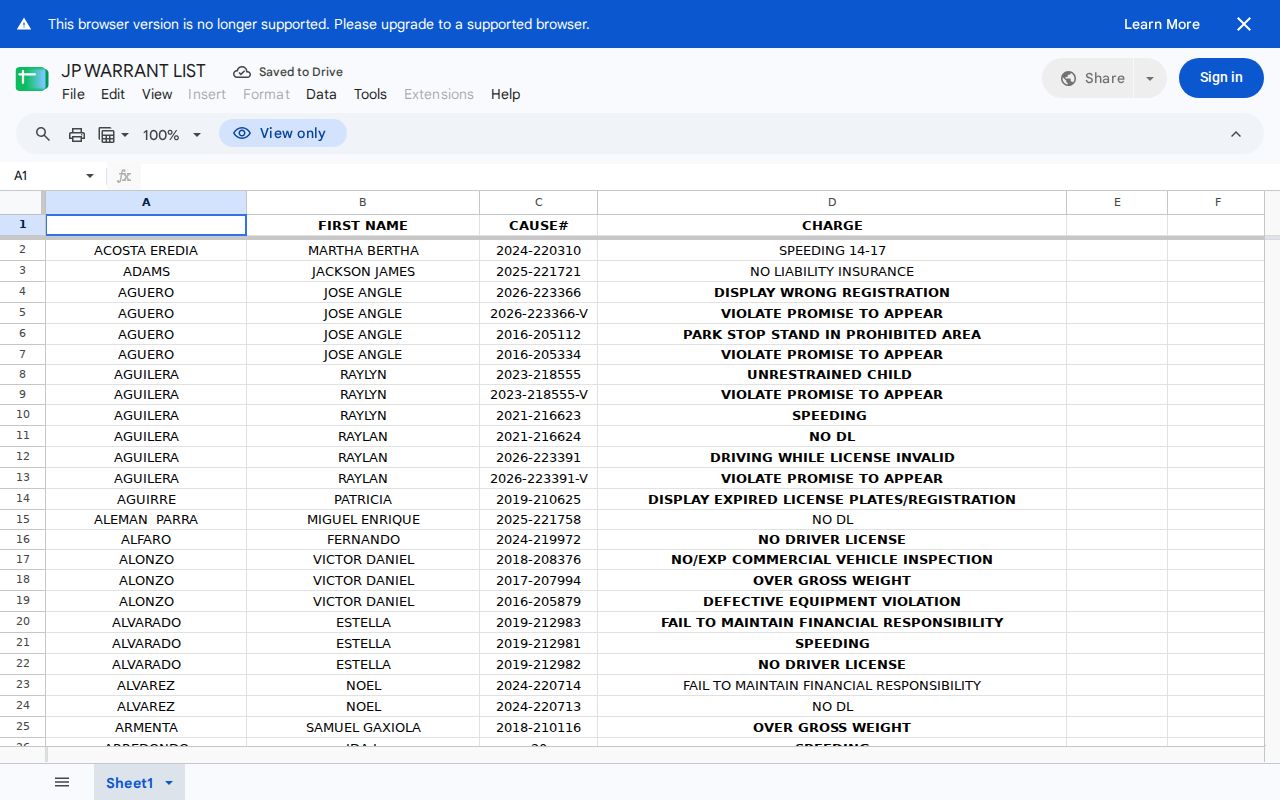
Its limited fields cannot replace the criminal register or a signed disposition.
Stages on a Deaf Smith Criminal Docket
Entries arrive in a sequence. The visible trail begins with a complaint, citation, information, or indictment, then appearance and arraignment where required. Pretrial settings, motions, and trial settings show the case moving, and a plea or verdict may give way to sentencing, judgment, post-judgment action, and appeal.
Docket flow: Filing › Arraignment › Pretrial › Plea or Trial › Disposition › Sentencing
Read the sequence rather than any one line. A setting can be reset and a charge can be changed, so the latest signed order beats an old calendar label as proof.
BENCH TRIAL on Deaf Smith Dockets
BENCH TRIAL is a setting label you will see on local dockets. It means the court scheduled a trial before the judge. No jury sits. The label alone does not prove the trial happened or reveal a result. Later entries must show whether it was held, reset, dismissed, or resolved by plea.
- Setting
- A scheduled event, not an outcome.
- Reset
- A move to another date.
- Disposition
- The recorded resolution of the case.
- Deferred disposition
- A result with conditions; the order controls.
- Nolle prosequi
- A prosecutor's choice not to proceed on a charge.
No official Deaf Smith code legend was found. Confirm vendor abbreviations with the clerk.
Which Court Holds Deaf Smith Criminal Dockets
The 222nd District Court serves as the general felony court for Deaf Smith County. It also serves Oldham County, with its records kept by the District Clerk. The constitutional County Court and its County Clerk hold county misdemeanors. JP cases and Hereford city cases stay with those courts.
An appeal may touch two record sets. Those are the originating clerk and the Seventh Court of Appeals. A notice, clerk's record, reporter's record, or appellate number may appear. A transfer can create a second number or a related entry. The Deaf Smith County case search offers a broader number-search workflow. Use it once you know the court.
Deaf Smith Criminal Portal Limits
iDocket is the county's named case-management system. Its search screen asks for a User Id and Password. That makes it a credentials-gated tool rather than a free open search. Its filing-date table can tell you when a county feed received new data. Yet it cannot locate a person or prove how a case ended.
re:SearchTX gives users Cases, Filings, Documents, and Hearings for participating courts. State guidance warns that criminal and older local coverage is incomplete. Filters and search modes help narrow what the portal covers. Case and hearing links open more detail. Document access can still depend on a user's role, a fee, or whether the court participates.
When nothing comes back, call the clerk or visit the counter. Ask whether the office accepts a precise written request. Give the court, full cause number, party name, and a narrow date range. Say whether you need a docket, a plain document, or a certified copy. The county posts no universal mail form, copy fee, or turnaround time. So call before you mail funds or identification. A portal result can also lag behind the signed order. Confirm current status with the clerk who keeps the record.
Public Access to Deaf Smith Criminal Dockets
Deaf Smith County criminal dockets don't move through the ordinary county records desk. The Texas Judicial Branch sets the access rules for court files. The clerk who holds each case handles the request. Limits still apply. Juvenile records, sealed cases, protected personal data, and restricted documents may be missing or redacted even where a docket entry is public.
Key Rules:
Texas Judicial Branch access policy explains the court-specific access framework.
Texas Rule of Judicial Administration 12 governs requests for judicial administrative records.
Texas Family Code Chapter 58 protects juvenile justice information.
Name the court, cause number, date range, and document type. If access is denied, ask in writing for the legal basis and the review route.
Verify Deaf Smith Criminal Dispositions
A docket line is not the order. Dismissed, deferred, convicted, and bond forfeiture each carry distinct legal effects. The labels matter. A signed judgment holds the terms a brief event entry leaves out. A downloaded image is not certified unless the clerk's method says so.
Ask the District Clerk, County Clerk, JP, or Municipal Court. State plainly whether you need a plain or certified copy. Certification charges, identity rules, and delivery times rest with the clerk. Confirm them before sending funds or personal data. And note: a scheduled BENCH TRIAL is not proof of guilt, acquittal, dismissal, or any other final outcome.