
How to Get Court Records
Pick the right office first. The Deaf Smith County District Clerk holds the files of the 222nd District Court. Those files cover district criminal, civil, family, juvenile, and adoption matters. The County Clerk keeps County Court cases. It also holds county misdemeanors and probate. Justice of the Peace files cover traffic, Class C, eviction, small-claims, and limited civil matters. Hereford Municipal Court handles city ordinance violations and fine-only Class C cases. A docket copy request aimed at the wrong office will stall.
For electronic records, try iDocket or re:SearchTX. Each has login rules, coverage gaps, and limits on which documents you can pull. The county publishes no universal mail form, records email, or drop box. Call the clerk before you mail payment or ID. A listed fax number can confirm instructions. Still, fax is not an established request channel here.
- Write down the exact court, full cause number, party name, and filing or order date.
- Decide whether you need a docket, plain document, certified copy, or transcript.
- Check the proper portal, then call the custodian if coverage or access is unclear.
- Ask about cost, payment, identification, format, archive retrieval, and turnaround.
- Describe a written judicial-record request precisely and keep any written response.
Deaf Smith Court Record Custody
Deaf Smith County splits record custody among offices. All of them share the courthouse at 235 East Third Street in Hereford. District Clerk Gloria Ellis sits in Room 304, at 806-364-3901. Her office runs Monday through Friday. Hours are 8:00 a.m. to 5:00 p.m. It closes from noon to 1:00 p.m. County Clerk Rachel Garman is in Room 203 at 806-363-7077, open the same weekday hours without a lunch closure.
The Justice of the Peace works out of Room 100 at 806-364-0999. Hereford Municipal Court lists 806-363-7127 and municipalcourt@herefordtexas.gov. Call ahead if the file may be old, sealed, or outside the usual clerk series. County pages do not promise a public terminal, same-day certification, or on-site copies.
Deaf Smith County District Clerk
235 East Third Street, Room 304
Hereford, TX 79045
806-364-3901
The official clerk page shows the office and its record role.
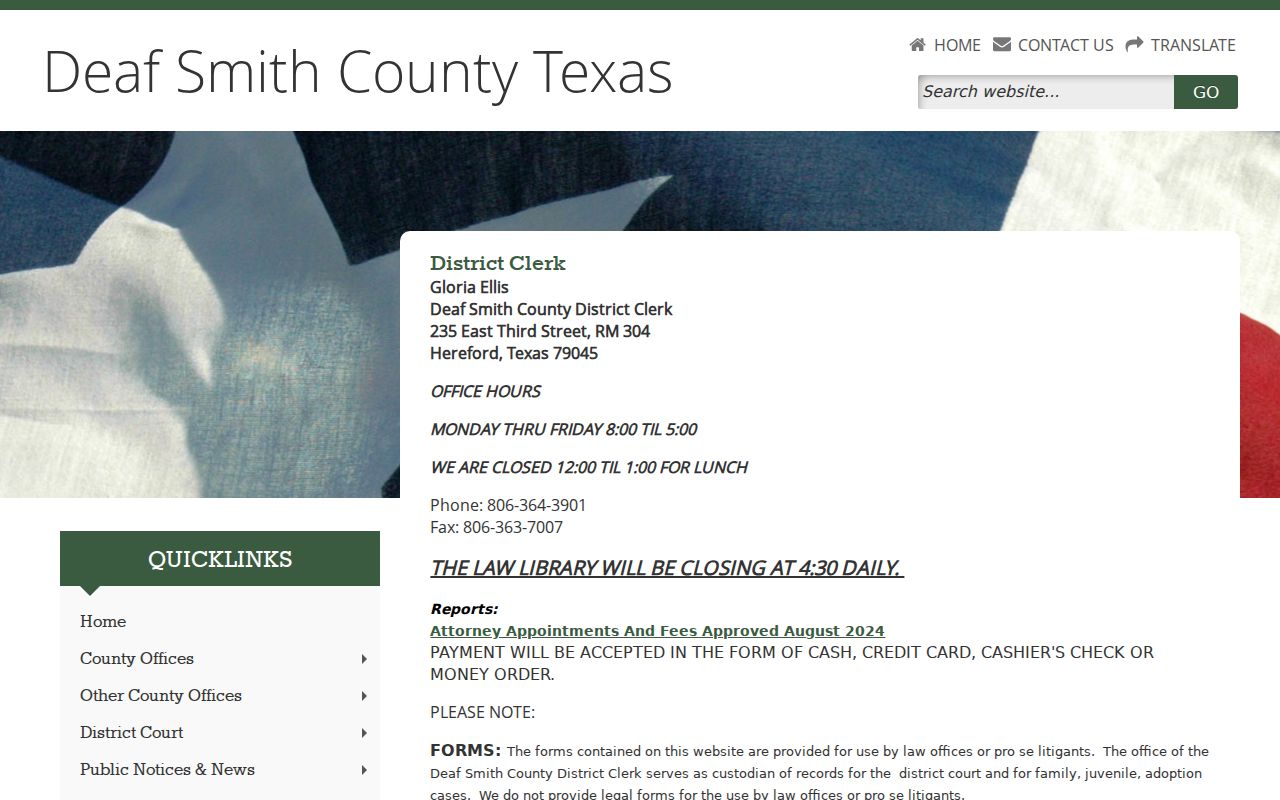
The district clerk publishes its hours, phone number, and accepted payment types, but not current copy prices, so ask the office for fees before you order.
Types of Court Records
A docket is only the index of a case. It shows when pleadings arrived, when hearings were set, and how the matter ended. The filed documents are the separate papers behind those entries. These include petitions, motions, orders, judgments, exhibits, citations, and returns. A certified copy carries the clerk's authentication for formal use. A document downloaded from an online search does not become certified on its own.
Record types in Deaf Smith County follow the court split. District files may hold felony, major civil, family, juvenile, and adoption material. Access rules vary. County Clerk files cover misdemeanor and probate matters. JP files include setting reports and traffic and Class C cases. Evictions, small claims, debt claims, and judgments appear there too. Municipal files cover Hereford ordinance and fine-only cases.
- Docket or register entries showing filings, settings, and disposition
- Pleadings, motions, citations, returns, exhibits, and attachments
- Signed orders, judgments, and post-judgment papers
- Certified copies issued by the lawful custodian
- Transcripts prepared through the court reporter
Before ordering any document, identify the case. The separate Deaf Smith County case search walks through the county and statewide lookup layers that help you do that.
Three Deaf Smith Record Products
Asking for "the record" without naming a product causes most delays. A Deaf Smith County docket confirms an order was entered. Yet it will not reproduce the signed order itself. A portal document may show the order's text but lack clerk certification. A certified copy adds authentication, though it usually takes a separate clerk request and fee.
- Docket or register
- A chronological index of case events, filings, settings, and results.
- Filed document
- The actual pleading, motion, order, judgment, exhibit, citation, or return in the file.
- Certified copy
- A reproduction authenticated by the custodian, distinct from a screen capture.
- Transcript
- A record of spoken proceedings obtained from the court reporter.
A JP Court Date Report is only a setting snapshot. Publication by the court does not turn it into a certified docket, a judgment, or a full court file.
What a Court Record Contains
What's inside depends on the court and case type. A Deaf Smith County file begins with the court, cause number, parties where public, filing date, and status. The docket then points to pleadings, service, settings, motions, signed orders, judgments, payments, appeals, and closing activity. Those papers stay separate from the index. Restricted data or documents may be redacted or withheld. The index entry can still stay public.
| Cause number | The unique identifier, including all punctuation, prefixes, and suffixes. |
|---|---|
| Case style | The public caption naming parties or the State of Texas and respondent. |
| Event list | Filings, service, settings, motions, orders, disposition, and later action. |
| Filed papers | Accessible pleadings, exhibits, citations, returns, orders, and judgments. |
| Setting details | Date, time, court, judicial officer, and setting type when recorded. |
| Disposition | The result, read with the signed order or judgment when precision matters. |
Local JP civil reports use CV-YY-#####, while JP criminal and traffic reports use YYYY-######. No district prefix is standard, so copy the full number exactly as the filing or clerk supplied it.
Deaf Smith Judicial Record Requests
Texas court records do not always fit the routine county-agency request. Courts and judicial agencies are not handled through the Texas Public Information Act or federal FOIA in the ordinary way. That rule comes from the Texas Judicial Branch open-records policy. Government Code section 552.0035 sends judiciary information to Supreme Court rules or other law. Rule 12 governs access to many non-adjudicative judicial records.
Write your request around the custodian, court, cause number, and document. Add the date range. Say whether you want inspection or copies. The custodian may grant access, ask for clarification, or deny it. A denial should state its basis. It should also note any Rule 12 appeal rights when that rule applies. Local clerk pages publish no universal Rule 12 email, tracking process, or response deadline.
One court, one cause, one date, one document. That is far easier to route than a demand for all county court records.
Certified Copies and Fees
Need a certified judgment or order from Deaf Smith County? Ask the District Clerk. Give the clerk the cause number and the document title. Add the filing or signing date. Say how many copies you want. It helps to ask early whether the item sits online or in storage. Ask which payment types work. Ask how you will get the copies back. The clerk accepts cash, credit card, cashier's check, and money order. Those lists say what you can pay with, not what you owe. Ask for the current fee before you send anything.
Deaf Smith County posts no plain-copy, certified-copy, exemplification, search, transcript, or archive-retrieval price. That gap is stated plainly. The page will not fill it with an old County Clerk schedule or a JP filing charge that would not apply here.
| Requested item | Current fee or route |
|---|---|
| Public docket or register | Portal if covered; court counter fallback. Copy fee not published. |
| Filed district or county document | Portal if covered or clerk request. Local charge not verified. |
| Certified judgment or order | Ask the proper clerk for current certification and copy charges. |
| Transcript | Request a quote from the relevant court reporter. |
| Older or archived file | Ask records staff about retrieval, fee, format, and timing. |
Deaf Smith Court Transcript Route
A clerk's file and a reporter's transcript are two different things. The District Clerk holds the docket and the filed orders. Live testimony lives with the court reporter. The Office of Court Administration lists a reporter for the 222nd District Court. Deaf Smith County itself publishes no transcript form. It lists no page price, no deposit rule, and no delivery schedule.
Call the court at 806-364-7222 and ask for the reporter who covered your hearing. Have the cause number and the proceeding date ready. Know the judge and the part you need. Then ask about estimated pages, the deposit, certified format, and delivery time. One caution: not every hearing on the docket was transcribed. The District Clerk cannot certify a reporter's work.
Public Access and Sealed Records
Public access in a Deaf Smith County case can vary by level. A case number may stay visible while a sealed filing stays withheld. Texas Rule of Civil Procedure 76a sets the core presumption. Civil records are open. Findings must come before qualifying records are sealed. Texas Family Code Chapter 58 protects juvenile information. Adoption plus some other family material carries its own limits.
Rule 21c shields certain government identification numbers. It also covers financial account numbers, birth dates, and covered data about minors. Redaction does not turn the rest of a public file into a secret. It simply means the clerk and the filer apply the rule that governs each piece.
Key Texas access rules:
Judicial Branch policy explains the judicial-record route.
Rule 12 provides a request and review framework.
Rules 21c and 76a address sensitive data and civil sealing.
The official access page is the clearest state source for this distinction.
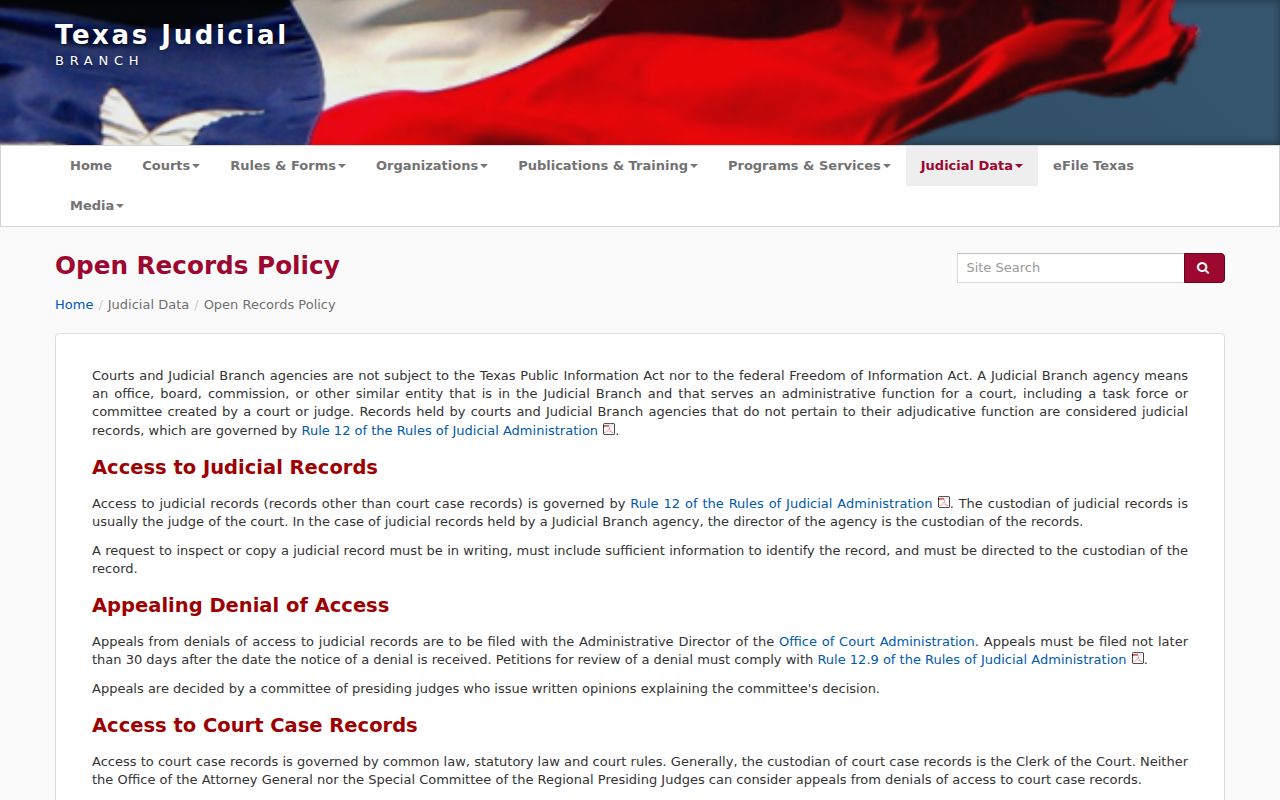
The policy behind that page shows why a blanket Texas Public Information Act request is only part of the answer for a court file. Sealed filings, redactions, and rule-based limits all sit outside what such a request can unlock.
Older Deaf Smith Court Files
Older Deaf Smith County court records may sit in paper files or bound docket books. Some sit in microfilm or scans. The county publishes no full archive inventory. It lists no digitization cutoff, no retention chart, no microfilm span, and no pre-digital online index. So a blank portal result does not mean an old case never existed. The file may simply fall outside the electronic feed or hide under another historical series.
Call the right clerk for the court level, District Clerk or County Clerk. Give any names used at the time. Add a rough year, the case type, and any cause number or order date you have. Ask which index survives. Ask whether staff must pull it by hand. Ask what a plain or certified copy costs. The courthouse has held the county's records since the marble-faced building was finished in 1910. Even so, no one promises every historical series has been scanned.