
How to Search the Deaf Smith County Court Docket
Start with the court that holds the case. A broad name search often returns noise. So begin with jurisdiction in Deaf Smith County and work from there. The iDocket Judicial Case Search pulls together County Clerk and District Clerk data. The live search, though, requires a subscriber sign-in before it shows anything. Beyond that portal, the county links its individual offices, daily Justice Court reports, and calendars. If a record is not online, the office phone, mail, counter, or a courthouse terminal still work.
Bring the party name, the case or citation number, and the likely case type. A name by itself invites false matches. Add the court name and filing year. The docket result then gets much easier to confirm.
- Decide whether the matter belongs to the 222nd District Court, constitutional County Court, Justice Court, or Hereford Municipal Court.
- Try iDocket or re:SearchTX with the exact case number; use a name search only when needed.
- Compare the court, party names, filing date, and case type before opening a result.
- Read the event list and confirm any hearing through the local court.
- Ask the correct clerk for a plain or certified copy when the online entry is not enough.
Deaf Smith County Docket Access Has Four Doors
Four different offices hold the pieces of a Deaf Smith County court docket. One office alone rarely tells the whole story. Felonies, major civil suits, family matters, and adoptions live with the District Clerk, while the County Clerk keeps county-level misdemeanors and probate files. The countywide Justice of the Peace handles evictions, small claims, Class C matters, and many traffic cases. City ordinance violations and fine-only Class C cases from Hereford go to the municipal court instead. So a docket search can look complete and still miss records sitting in another office.
| Starting fact | First office | Useful channel |
|---|---|---|
| District case number or felony | District Clerk | iDocket, re:SearchTX, phone, mail, or counter |
| County misdemeanor or probate | County Clerk | iDocket, phone, mail, or counter |
| Eviction, small claim, JP traffic | Justice of the Peace | Daily reports, linked calendar, phone, or counter |
| Hereford citation | Hereford Municipal Court | Clerk by phone or email; city site for routing |
What a Court Docket Shows
A Deaf Smith County court docket is an index of what happened. It is not always the full set of document images. The county's Court Date Reports carry practical calendar fields, while re:SearchTX sorts data into cases, filings, documents, and hearings. A certified file still has to come from the clerk or court that keeps it.
| Case Number | The court's identifier; the sampled JP reports used values such as J2-26-0022. |
|---|---|
| Parties | Named participants, subject to redaction and access limits. |
| Filing or Event | A complaint, motion, order, notice, plea, or other recorded step. |
| Setting | The hearing date, time, type, and status when supplied. |
| Court and Judge | The court responsible for the event and judicial officer when listed. |
| Disposition | The recorded outcome, which may follow several earlier settings. |
iDocket Is a Local Index, Not the Courthouse File
Deaf Smith County has used iDocket for county case information since the County Clerk's 2020 announcement. The vendor's e-filing support list names the County Clerk, County Court, District Clerk, and 222nd District Court. The county filing-date table helps you judge how fresh a participating system may be, though it does not prove that every new filing is visible.
The judicial search screen asks for a subscriber sign-in and carries the vendor's disclaimer. Treat the portal as a locator. When an entry is missing, delayed, or too thin, contact the local clerk. The official file, the certified copy, and the authoritative setting all stay with the court.
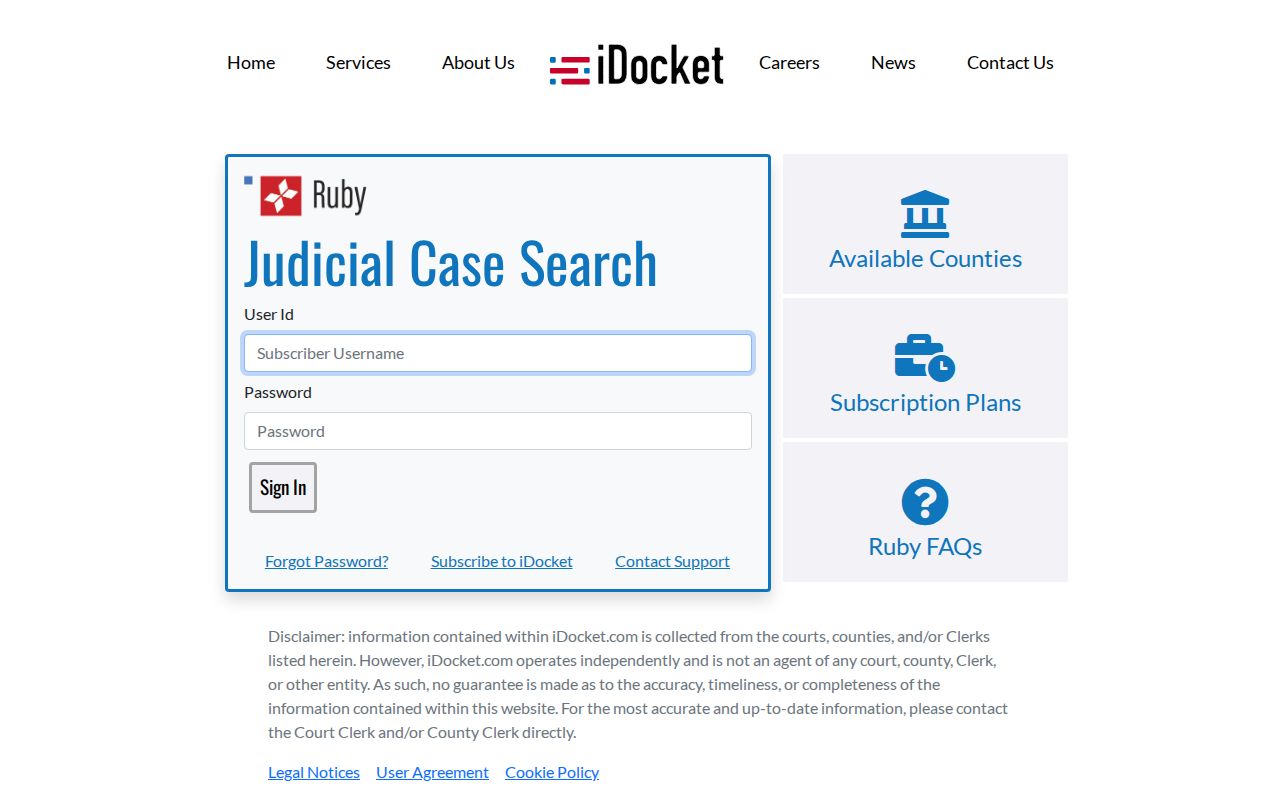
That sign-in state is the reason a phone, mail, or counter fallback belongs in any complete Deaf Smith County docket search.
Which Courts Keep Dockets
Texas trial jurisdiction is divided by subject and seriousness. The 222nd District Court serves Deaf Smith and Oldham Counties as the general-jurisdiction court. No single countywide docket collects every matter from the lower courts. The filing court controls where a docket search begins.
| Court | Docket covers | Custodian |
|---|---|---|
| 222nd District Court | Felony, major civil, family, adoption, and district matters | District Clerk |
| Constitutional County Court | County misdemeanors, limited civil and appellate work, probate | County Clerk |
| Justice of the Peace | Small claims, debt claims, evictions, Class C and traffic matters | Justice Court |
| Hereford Municipal Court | City ordinances and fine-only Class C cases | Municipal Court clerk |
The 222nd District Court Serves Two Counties
The official District Court page places the 222nd District Court at the Deaf Smith County Courthouse. Its district crosses into Oldham County. A name that turns up in a statewide tool still has to be checked against the county of filing, because a 222nd District Court label alone does not settle which clerk holds the paper or electronic file.
A Deaf Smith filing belongs with the Deaf Smith District Clerk. Appeals from local state trial courts go to the Seventh Court of Appeals, while final civil and criminal review sits with different Texas high courts. Appellate dockets are separate from the trial docket described here.
Finding Court Dates and Settings
A future date on a Deaf Smith County court docket could be a docket call, arraignment, pretrial setting, trial, or a compliance hearing. Never infer the event type from the date alone. Justice Court publishes linked daily Civil and Criminal Court Date Reports. Its county page also points to a Google Calendar. The general county calendar offers day, week, month, and agenda views. It adds print, iCal, and RSS controls.
Read the event label and status, then confirm with the court near the appearance date. A reset creates a later entry; it does not erase the earlier one. For the full channel-by-channel process, see the Deaf Smith County court calendar.
Justice Court Reports Show the Local Calendar Shape
The JP Court Date Reports beat a generic month grid. They group scheduled cases and expose the record fields. The civil report included a case number, case category, filed date, plaintiff, defendant, balance, and service status. The criminal report listed a case number, defendant, offense, offense date, plea, and status. Party names from those reports are left out here.
- Court Date Report
- A published list for a stated court date, not a complete case file.
- Service status
- A civil-case field showing whether required delivery has been recorded.
- Plea
- The response recorded in a criminal matter, when one has been entered.
- Reset
- A move to another setting that should be confirmed through the court.
Public Access to Dockets
Texas access rules separate case records from administrative records of the judiciary. The Texas Public Information Act does not automatically govern judicial records the way it governs executive agencies. Court rules, confidentiality statutes, sealing orders, and each court's own access process all matter.
Key Rules:
Texas Government Code Chapter 552 places the judiciary outside the Act's ordinary definition of a governmental body.
Texas Rule of Judicial Administration 12 supplies a request and review framework for judicial administrative records.
Texas Rule of Civil Procedure 76a addresses sealing and the presumption applied to court records within its scope.
Texas Family Code Chapter 58 protects juvenile justice information.
Some Deaf Smith County Docket Details Stay Restricted
Public access does not open every document. Some personal details stay restricted. Juvenile material is confidential under Texas law. Adoption files, sealed cases, and protected family material can be withheld. Rule 21c requires sensitive data to be redacted from filed documents. When a restriction applies, a public index may show only limited case information. It may show no result at all.
A blank portal response is not proof that no case exists. Check the court, the spelling, and the case number. Then ask the clerk whether the record is public. The clerk can explain access procedure but cannot give legal advice or open a sealed file without authority.
re:SearchTX Adds a Statewide Layer
re:SearchTX adds a statewide layer to any Deaf Smith County docket search. The portal covers electronic cases, filings, documents, and hearings for Texas courts that take part. Its quick guide walks through account-based searching. Filters cover case number, party, filing, document, and hearing. Coverage is not uniform. Criminal information runs thin there, and many documents stay locked. The Texas Judicial Branch says so plainly: no single trial-court portal is complete.
Treat a statewide hit as a lead, not the finish line. Find the court and the case number. Then go back to the Deaf Smith County clerk for the authoritative court record. Lawyers and parties file through eFileTexas. That filing channel is not a promise of free public access to every document.
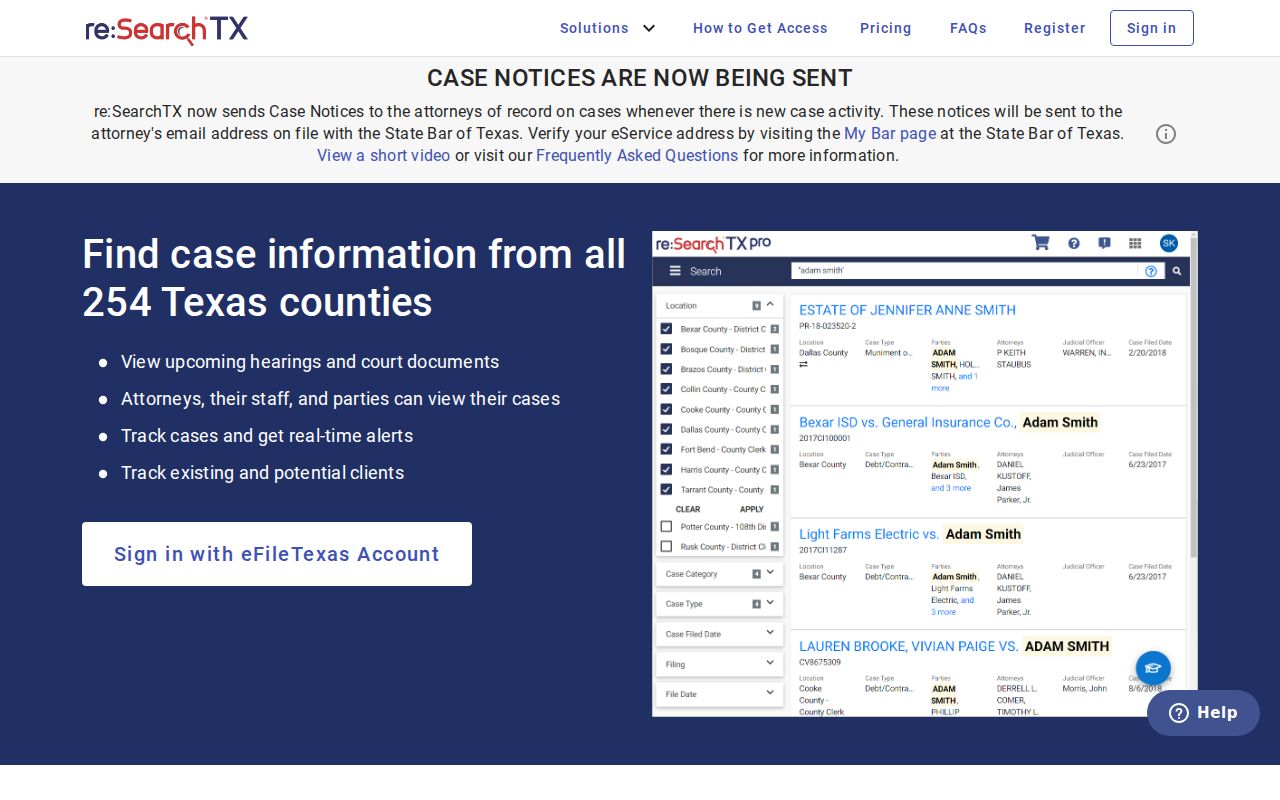
When the statewide layer falls short, the local Deaf Smith County clerk is still the shortest route to the docket.
The Clerk and Docket Records
Deaf Smith County splits record keeping between two clerks. The District Clerk holds District Court records: criminal, civil, family, and adoption. The County Clerk keeps the constitutional County Court side of the house. Whichever office you contact, be specific. Name the court, the case number, the parties, and the exact item you need. Also say what form fits. A plain copy, a certified copy, and a simple setting confirmation serve different purposes.
Deaf Smith County District Clerk
235 East Third Street, Room 304
Hereford, TX 79045
806-364-3901
Deaf Smith County Clerk
235 East Third Street, Room 203
Hereford, TX 79045
806-363-7077
The Courthouse Is the Reliable Offline Fallback
The Deaf Smith County Courthouse sits at 235 East Third Street in Hereford. Its offices handle many questions in person. Room numbers matter. Show up at the wrong counter. The staff there may not hold the docket you asked for. A quick call first settles hours, availability, payment methods, and any prep the office expects.
The District Clerk page posts weekday office hours plus payment guidance, and those payment limits can shift by transaction. Mail requests work best when they are specific and carry a return contact. Never guess at a fee. Confirm the amount and the accepted form of payment before sending anything.
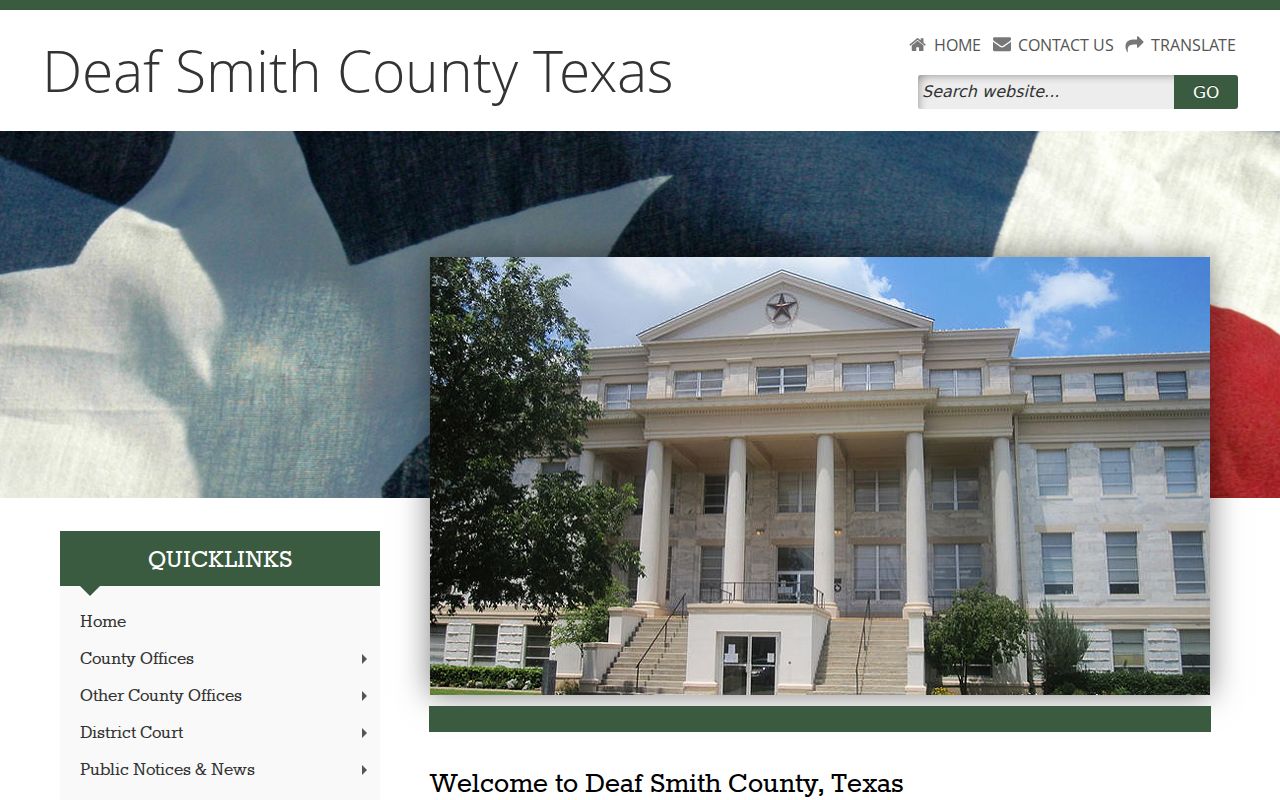
The image also helps distinguish the official county source from vendor search pages.
Deaf Smith County Docket Terms in Plain English
Short event labels can make a docket entry look final when it is not. Read entries in date order, and tell a filing apart from an actual ruling.
- Filed
- The clerk accepted an item into the record; the court has not necessarily ruled on it.
- Setting
- A scheduled event that can later be reset or cancelled.
- Order
- A written direction or decision entered by the court.
- Disposition
- The recorded resolution of a charge, claim, or case stage.
- Certified copy
- A clerk-authenticated reproduction, different from a portal printout.
Always read later docket entries because a new order or reset can change the meaning of an older event.
Court Dockets by City in Deaf Smith County
Hereford is the county seat and Deaf Smith County's only incorporated city. The Hereford Municipal Court handles city ordinance matters. It also hears fine-only Class C cases, including municipal traffic tickets. Its jurisdiction stops there. Anything more serious rises to the county or district level, even when the event happened inside Hereford.
Hereford Court Docket
2020 Census population 14,972 · Municipal citations start with the Hereford Municipal Court clerk.
Check before you rely on a Deaf Smith County court docket result. Compare it against the originating court's current record. Save the case number, court name, and event date rather than trusting a name alone. Portals and official notices can disagree. Ask the clerk whether the matter was reset, transferred, sealed, or filed under a different number.
An event list shows sequence, nothing more. It cannot replace a signed order or a clerk-certified copy. Mail requests should describe the exact item. Confirm the current charge and payment method first. In person, verify the courthouse room and the office hours. These steps keep everything in its place. A docket index, a document image, and the official court file stay distinct.
Map and Directions to the Deaf Smith County Courthouse
District Court records for the 222nd Judicial District Court are kept by the District Clerk in Room 304 of the Deaf Smith County Courthouse, 235 East Third Street, in Hereford, the county seat. The same courthouse also holds the County Clerk in Room 203, the constitutional County Court in Room 201, the 222nd District Court itself in Room 305, and the countywide Justice of the Peace in Room 100. The marble-faced courthouse was completed in 1910, according to Texas State Historical Association records, replacing an earlier frame building that was moved to the site by wagon. The District Clerk's office is open weekdays from 8:00 a.m. to 5:00 p.m., closed for lunch from noon to 1:00 p.m.
Deaf Smith County District Clerk
235 East Third Street, Room 304
Hereford, TX 79045
806-364-3901
Monday through Friday, 8:00 a.m. to 5:00 p.m. (closed for lunch, noon to 1:00 p.m.)
No parking, security-screening, elevator, or public-terminal details for the Hereford courthouse were published, so call 806-364-3901 to confirm hours and the correct room before a visit; the federal Amarillo courthouse's identification and electronics rules should not be assumed to apply here.